
Protect the Feeling
I shot 93 on Tuesday.
There’s nothing special about that score. Golfers have rough rounds all the time, and a 13-handicap shooting 93 isn’t a big deal. I’ve played worse before, and I probably will again. But for some reason, this one stuck with me. The odd thing wasn’t playing badly. It was how much it bothered me that I did.
Since moving to Cobble Creek, I’ve started taking golf seriously. I’ve practiced with purpose, played in money games, joined a league, tracked my greens in regulation, and watched my handicap as closely as someone checks a favorite stock. I’ve worked on my putting, learned how to compress an iron, finally found a driver I trust, and probably spent too much time thinking about course management. I’ve shot 75. I’ve shot 77. I’m starting to see flashes of the golfer I could become.
That has been enormously satisfying, but it has also created a problem: once you know you can shoot 77, shooting 93 feels different.
The good rounds start to feel like proof. They set a standard in your mind that the handicap system never actually promised. A 77 stops feeling like a great day and starts to seem like proof you should always play that well. If you can do it once, you think, why not again? Before long, an 84 feels like a letdown, an 88 needs an excuse, and a 93 turns into a mystery to solve.
Somewhere in there, the game begins to change.
I started thinking about Erik Anders Lang. What I’ve always liked about how he approaches golf isn’t that the score doesn’t matter—he clearly loves the game too much for that. It’s that golf always seems bigger than just the score. There are courses, people, landscapes, odd bounces, long walks, and conversations you’d never have anywhere else. The golf itself matters a lot, but it’s not always the most interesting part of the day.
I realized I needed some of that back.
It’s not that I want to stop getting better. In fact, it’s the opposite. I still want to see how good I can get. I want to become a single-digit handicap, and then see if I can go even further. I enjoy competing. I like the nerves that come with an important putt. I like stepping onto the first tee knowing the score matters. But there is a distinction I had allowed to become blurred: wanting to become a great player is different from feeling like I have to play great today.
The first goal can guide years of meaningful effort. It gets you into the gym in January, onto the practice green in March, and back to the range after a round you’d rather forget. It gives your curiosity a purpose. The second can ruin an otherwise good Tuesday afternoon.
The morning after shooting 93, I woke up feeling clearer after a good night’s sleep. I decided to head back out by myself. I didn’t have a big plan. I wasn’t trying to fix anything or prove the 93 was a fluke. I just wanted to walk eighteen holes and play golf.
I brought a camera.
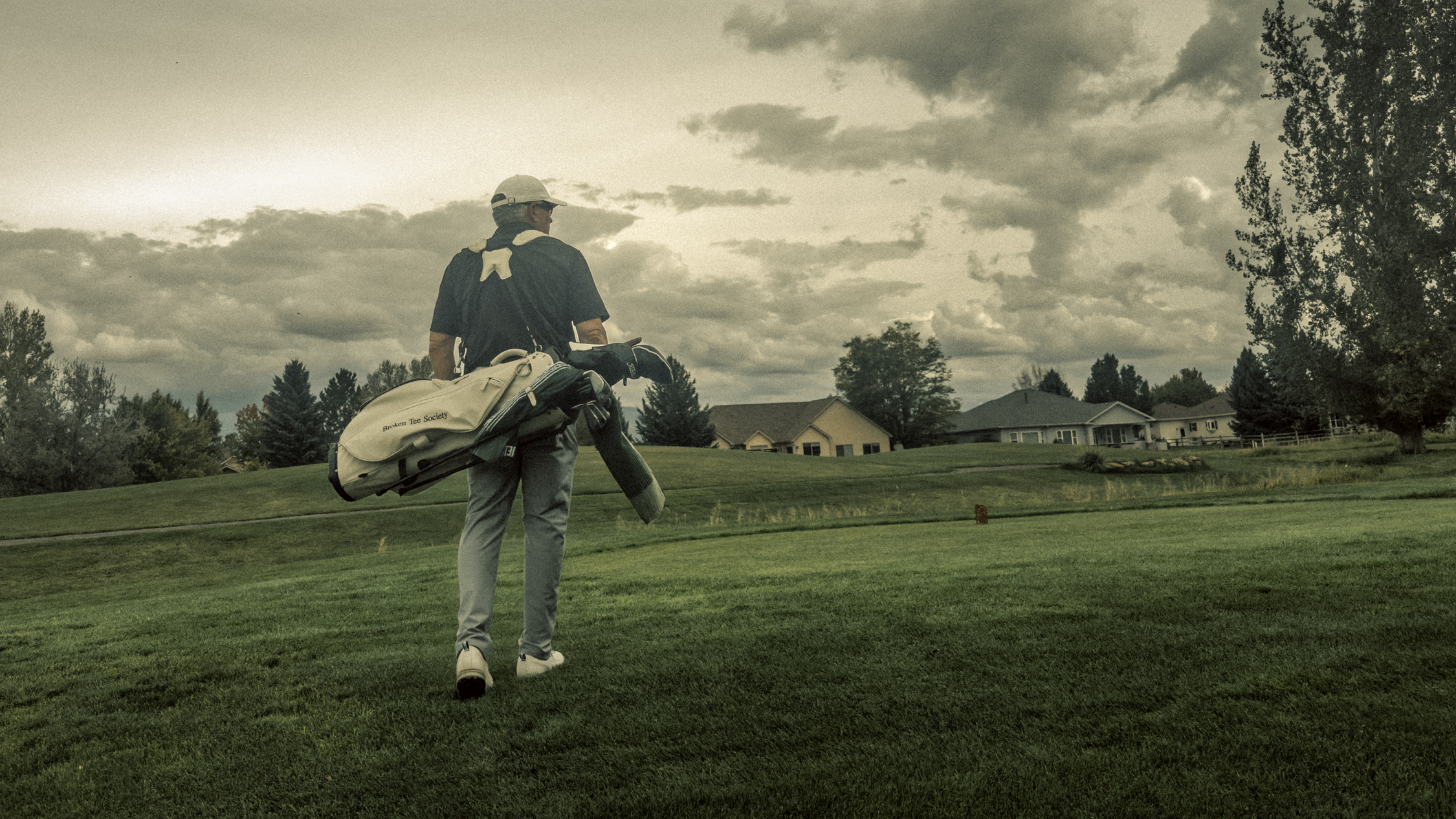
Photography has been part of my life for a long time, but I didn’t want this round to become a photo project. That would just swap one kind of performance for another. I decided that if something caught my eye, I’d take a picture. Otherwise, I’d just keep walking. I made nineteen photographs over eighteen holes: a golf bag on my shoulder under a huge Colorado sky, the view from the ground as I crouched behind a putt, a green beneath heavy clouds. Nothing special, really.
Just the kind of things you see on a golf course but stop noticing when you’re only thinking about your score.
Except I noticed them. And somewhere during the walk, I stopped thinking about the 93.
The golf showed up too. A better player at my club had told me the day before to use my legs more. I’d been struggling with my irons, sometimes hitting shots that made me question if I’d ever swung a club before. But this time, I felt my weight shift to my lead side during the downswing, and suddenly my contact improved. The ball compressed and took off. I stopped trying to hit the 7-wood hard, and it went farther. I did the same with the driver.
Easy swings gave me the shots I’d been trying to force before.
I hit ten greens. The driver behaved. A couple of birdie putts caught edges without falling. I got tired over the final few holes and leaked a couple of strokes. When it was finished, the card said 83—ten shots better than the day before.
But that wasn’t really the point. The point was that I had enjoyed myself. Really enjoyed myself.
I walked alone with my clubs under a cloudy Colorado sky. I hit some great shots and some I’d rather forget. Sometimes I stopped just because the light, the clouds, or the shape of the course made me want to take it in. I played quickly and focused on the next shot, not the last score. For a few hours, golf stopped being an evaluation of my progress and became golf again.
There’s a risk in getting too serious about something you love. Getting better feels great. Keeping track of progress is helpful. Competing teaches you things you’d never learn otherwise. None of these are bad things. The problem comes when they become the cost of enjoying the game.
If I need to play well to enjoy golf, I’m giving too much power to a little white ball. A bad bounce can ruin my day. A cold putter can affect how I feel about myself. A number in GHIN can decide if the day was worth it. That isn’t what I want from the game.
I want golf to keep me curious and keep me walking. I want to carry my bag as long as I can, and work to make sure I can do it for years. I want to play new courses and figure out why someone put a bunker in a certain spot. I want competitive rounds that make my hands shake, quiet rounds with my wife, and afternoons alone when all that matters is the next shot.
And yes, I still want to see how low the handicap can go. That hasn’t changed. What has changed is where I want the handicap to sit in the hierarchy. It can measure my golf. It doesn’t get to define my relationship with it.
Maybe that’s what the 93 was good for. Golf often teaches us lessons we didn’t expect, and they usually cost more than we think. I thought my problem was forgetting how to hit an iron, but by the next afternoon, I realized I’d forgotten something even more important: why I wanted to hit one in the first place.
I don’t walk because walking helps me play better golf. I play golf, in part, because I love to walk. There is a difference.
I’m still going to practice. I’m still going to compete. I’m still going to count greens and study the numbers and wonder whether I can become the player I can occasionally see from a distance. But I’m going to protect the feeling underneath all of it.
Someday the handicap won’t matter. The scorecards will disappear into a drawer. Nobody will remember whether I was a 13 or a 9 or a 4.
I suspect I’ll remember the walks.
Until Next Time,
MVM